Bathtub leaks usually show up in one of three ways:
- You see water where it shouldn’t be (on the floor, ceiling below, or behind the wall).
- You hear/notice dripping (even when the tub isn’t running).
- Your tub won’t hold water (slowly drains down).
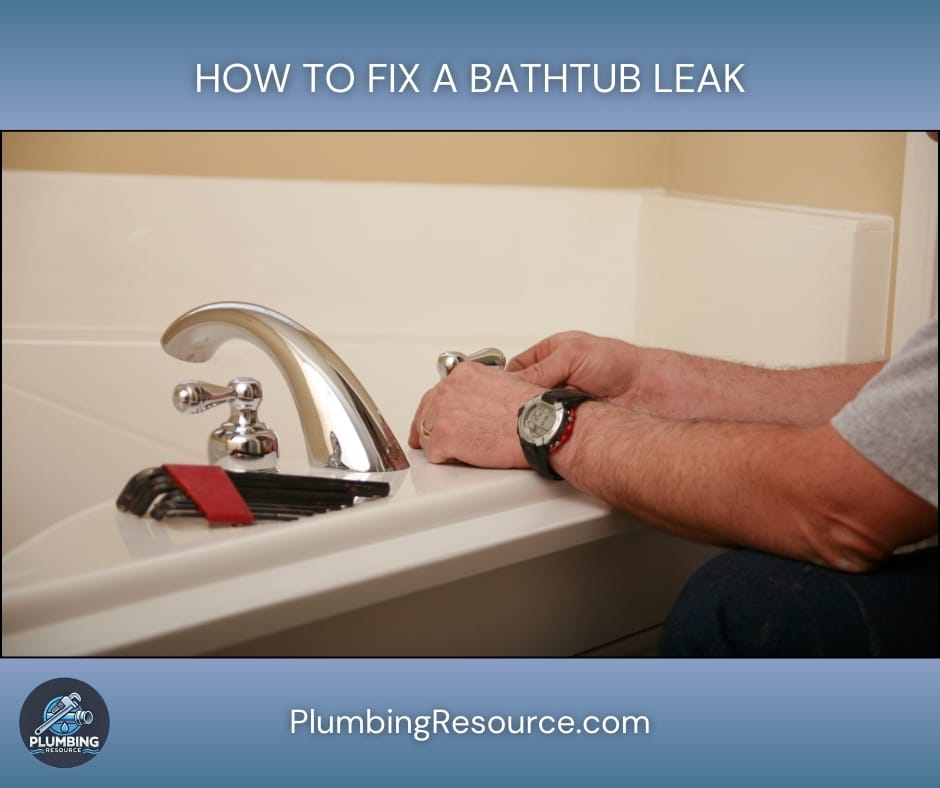
This guide walks you through how to find the exact leak, then how to fix it, whether it’s a faucet/valve, spout, shower arm, drain/overflow, the tub itself, or the piping below.
Safety First (Don’t Skip This)
- If water is dripping into a ceiling below, place a bucket, poke a small “drain hole” in the bulging drywall if needed to relieve weight (waterlogged drywall can collapse), and shut off water until you identify the source.
- Turn off power to any nearby light, fan, outlet, or ceiling fixture that might be getting wet.
- Shut off the water:
- Preferably at the fixture stops (if accessible), or
- At the home’s main shutoff if you can’t isolate the tub.
- If your tub is part of a multi-story home, leaks can travel along framing-what you see may not be directly under the leak.
Tools & Materials (Grab What Matches Your Situation)
You won’t need everything-choose based on the leak type.
- Flashlight/headlamp, towels, bucket
- Screwdrivers (Phillips/flat), Allen keys (for handle set screws)
- Adjustable wrench, channel-lock pliers
- Utility knife, putty knife
- Plumber’s grease (silicone-based) for O-rings/cartridges
- Plumber’s tape (PTFE) for threaded shower arms
- Replacement parts (as needed): cartridges, seats/springs, stems, O-rings, diverter, spout, overflow gasket, drain gasket/putty, tub shoe, waste & overflow kit, slip-joint washers
- Silicone caulk (kitchen & bath), grout repair products (if tile-related)
- Tub drain wrench / drain extractor tool (helpful for stuck drains)
Step 1: Identify Where the Leak Is Coming From (The Most Important Part)
A. Determine when the leak happens
Use this quick test sequence:
Test 1 – Leak with EVERYTHING OFF
- Dry all surfaces.
- Don’t run water anywhere.
- Watch for 10–20 minutes.
If it leaks with the tub unused, it’s usually: - A dripping tub spout or showerhead caused by a faulty valve/cartridge, OR
- A pressurized supply connection leaking behind the wall (rare, but serious).
Test 2 – Leak only when WATER IS RUNNING (tub spout or shower)
- Run water into the tub, but do not plug the drain.
If it leaks only while water runs, suspect: - Spout connection, shower arm threads, valve body/trim issues,
- Drain overflow piping leak (if water hits the overflow),
- Or a leak that only appears under flow pressure.
Test 3 – Leak only when the TUB IS FILLED AND DRAINING
- Plug the tub and fill it to a few inches below overflow.
- Mark waterline with a piece of tape.
- Wait 15 minutes.
- Then pull the plug and watch during drain.
If it leaks during fill/hold, suspect: - Drain flange seal, tub shoe gasket, overflow gasket, crack in tub.
If it leaks only while draining, suspect: - Waste pipe connections, slip joints, tub trap, drain tee.
Test 4 – Leak only when WATER HITS THE OVERFLOW
- Fill tub until water enters the overflow opening.
If leak begins then, the overflow gasket or overflow tube connection is the prime suspect.
B. Where do you see the water?
Use what you see to narrow it fast:
- Dripping from tub spout or showerhead when off → valve/cartridge not sealing.
- Water behind the escutcheon (trim plate) → valve stem/cartridge seal or a missing/damaged foam gasket; sometimes water is entering through the plate and running into the wall.
- Water on tub deck or around spout → spout connection or caulk failure.
- Water at the tub-to-wall line → caulk/grout failure or splash/deflection issue.
- Water below (ceiling stain under tub) → drain/overflow/tub shoe/trap or supply leak.
- Tub won’t hold water → drain stopper seal, drain flange/gasket, tub crack.
Step 2: Fix Leaks at the Faucet/Valve (Most Common “Drip When Off” Issue)
If your tub spout or showerhead drips after shutoff, the valve isn’t sealing.
Scenario 1: Single-handle tub/shower (cartridge type)
1) Shut off water and relieve pressure
Turn the handle on briefly with water off to relieve pressure.
2) Remove handle and trim
- Look for a tiny set screw under the handle (Allen key).
- Pop off the decorative cap if needed.
- Remove the handle, then remove the trim plate (escutcheon).
- Keep track of screw lengths and orientation.
3) Identify and remove the cartridge
- You may see a retaining clip, nut, or screws holding it.
- Pull straight out. If stuck:
- Wiggle gently,
- Use a cartridge puller if necessary,
- Avoid prying against the valve body (you can crack it).
4) Replace cartridge (best) or service seals (sometimes)
- Match the cartridge exactly (brand/model matters).
- Lightly grease O-rings (silicone grease only).
- Install new cartridge in the same orientation.
5) Reassemble and test
- Turn water on, check for leaks behind the wall opening.
- Test hot/cold, diverter function, and confirm drip stops.
If it still drips:
- Confirm cartridge is seated fully and clip is installed.
- If your valve uses separate seats and springs (common on some brands), replace those too.
Scenario 2: Two-handle tub (stems/washers or ceramic discs)
1) Remove handles and trim
- Shut off water.
- Remove handle(s), then remove escutcheons.
2) Pull the stems
- Use a deep socket or adjustable wrench depending on stem style.
3) Determine stem type
- Compression washer type: rubber washer at the end seals on a seat.
- Ceramic disc: usually needs stem replacement; washers aren’t the fix.
4) For compression stems: replace washer + check/replace seat
- Replace the washer and screw.
- Inspect the valve seat inside the body:
- If pitted or rough, replace it with a seat wrench.
- If it’s integral (non-removable), you may need a valve rebuild/replace.
5) Reassemble and test
A properly rebuilt compression valve should shut off without overtightening.
Step 3: Fix Leaks at the Tub Spout and Diverter
Scenario 1: Water leaking behind/around the spout
This is often a bad seal at the wall or a failing connection.
1) Determine spout type
- Slip-on spout: small set screw underneath near wall.
- Threaded spout: twists off by turning counterclockwise.
2) Remove spout
- Slip-on: loosen set screw, pull straight off.
- Threaded: rotate carefully; support the pipe so you don’t twist it inside the wall.
3) Inspect and fix
- Slip-on: check copper stub-out for dents/corrosion; replace O-ring inside spout if applicable; reinstall and tighten set screw snug (not crushing pipe).
- Threaded: clean threads, apply PTFE tape (or pipe dope rated for potable water), reinstall snug.
4) Seal the spout-to-wall joint
Apply a neat bead of tub/sink silicone around the top and sides (leave the bottom uncaulked so any future leak can reveal itself).
Scenario 2: Diverter not diverting and causing weird leaks
If water leaks from the showerhead when filling the tub, or diverter doesn’t hold:
- Replace diverter spout (common easiest fix).
- Or service diverter valve if your setup has a separate diverter.
Step 4: Fix Leaks at the Shower Arm and Showerhead
If water drips from the arm connection behind the wall, it can run inside the wall cavity.
1) Remove showerhead
Turn counterclockwise. Use a cloth to protect finish.
2) Check shower arm tightness and seal
- If the arm is loose, carefully remove it.
- Wrap threads with PTFE tape (clockwise 6–10 wraps).
- Reinstall snugly-don’t over-torque and crack a drop-ear elbow.
3) Reinstall showerhead
Tape the showerhead threads if required (some heads use rubber washers and don’t need tape).
Step 5: Fix Leaks at the Drain Stopper (Tub Won’t Hold Water)
If the tub won’t hold water, the leak might not be plumbing-it might be the stopper seal.
Scenario 1: Lift-and-turn / toe-touch stopper
- Remove stopper (often unscrews or has a set screw).
- Check rubber seal at the bottom-replace if hardened or missing.
Scenario 2: Trip-lever stopper (overflow lever)
- Remove overflow plate and linkage.
- Clean hair/soap buildup.
- Adjust linkage so the stopper seats fully.
- Replace worn plunger/stopper if needed.
Step 6: Fix Leaks at the Drain Flange and Tub Shoe (Common “Leak Into Ceiling Below”)
If you see water below when the tub is filled or draining, drain seals are prime suspects.
Access note
Some tubs have an access panel (behind tub wall, closet, or ceiling below). If you can access the drain plumbing, your job becomes much easier and safer.
Scenario 1: Leak at the drain flange (top part you see)
1) Remove the drain flange
- Use a tub drain wrench or drain extractor.
- Turn counterclockwise.
- If it’s stuck:
- Use penetrating oil carefully,
- Or a drain removal tool that bites into the crossbars,
- Avoid cracking the tub finish.
2) Remove old sealant
Clean off old plumber’s putty/silicone from tub surface.
3) Re-seal and reinstall
- For most metal drains on non-porous surfaces: plumber’s putty is common.
- For some materials (certain plastics, stone, or manufacturer instructions): use silicone instead.
- Press flange down evenly and tighten until snug; wipe squeeze-out.
4) Test
Fill tub a few inches and inspect below (or watch for ceiling drip).
Scenario 2: Leak at tub shoe gasket (under the tub)
This is the seal between the tub and the shoe assembly.
1) Access under tub and inspect
Look for dripping at the shoe when tub holds water.
2) Tighten carefully first
Sometimes it’s simply loose. Don’t overtighten and crack fittings.
3) If tightening doesn’t work: replace the gasket
- Disassemble shoe connection.
- Install new gasket aligned flat (no twists).
- Reassemble and test during fill and drain.
Step 7: Fix Leaks at the Overflow (Leak Only When Water Reaches Overflow)
Scenario: Overflow gasket failure (very common)
1) Remove overflow cover plate
Two screws usually. Pull plate gently; linkage may come with it.
2) Inspect gasket position and condition
A tub overflow gasket often sits between tub and overflow elbow. It can:
- Flatten over time,
- Crack,
- Or be misaligned.
3) Replace gasket
- Match shape (sometimes beveled).
- Align carefully so it seals evenly around opening.
4) Reinstall plate/linkage and test
Run water until it enters overflow, then check below for drips.
Step 8: Fix Leaks in the Waste & Overflow Pipe, Trap, and Slip Joints
If it leaks only while draining, it’s often a joint below.
1) Run the drain and watch each joint
Use a dry paper towel around joints to find the first wet spot.
2) Common fixes
- Slip-joint nut leak: loosen, check washer, re-seat, then tighten hand tight + small turn.
- Cracked washer: replace with correct size.
- Cross-threaded nut: remove, realign, rethread gently.
- Corroded metal trap: replace section(s). If heavily corroded, replacing the entire trap is often smarter than chasing leaks.
3) Confirm slope and alignment
Pipes under tension leak over time. Realign so pipes “rest” naturally without forcing.
Step 9: Fix Leaks at the Tub Itself (Cracks, Failed Caulk, Tile/Grout Issues)
Scenario 1: Failed tub-to-wall caulk (water on floor, no plumbing leak)
1) Confirm it’s splash/caulk, not plumbing
Run shower spray at the wall/tub seam while someone checks below/adjacent area.
2) Remove old caulk completely
- Use a plastic scraper/utility knife carefully.
- Clean residue with appropriate remover.
3) Dry thoroughly
This matters. Caulk over moisture fails fast.
4) Apply new silicone
- Use bathroom-rated silicone.
- Smooth bead; ensure continuous seal.
- Leave bottom of spout uncaulked as mentioned earlier.
Scenario 2: Tile/grout failure
If grout is missing or cracked:
- Re-grout or use grout repair product.
- Seal grout afterward if applicable.
Scenario 3: Hairline crack in tub (acrylic/fiberglass)
- Use a tub repair kit rated for your tub material.
- If crack flexes or grows, the tub may need professional repair or replacement.
Step 10: Final Testing Checklist (So You Know It’s Fixed)
After any repair, test in this order:
- Valve test: water off → confirm no drip from spout/showerhead over 10 minutes.
- Flow test: run tub spout 3–5 minutes → check spout, trim, wall, and below.
- Hold test: plug tub, fill 4–6 inches → wait 15 minutes → check below.
- Drain test: pull plug, watch drain + trap joints while draining.
- Overflow test: run until overflow engages → confirm no leaks.
When to Call a Pro (Smart Stops)
Call a licensed plumber if:
- You suspect a pressurized leak inside the wall (wet with everything off).
- You find moldy, saturated, or collapsing materials.
- The valve body is damaged or you need a valve replacement (often requires soldering/crimping and proper access).
- Your plumbing is old galvanized/cast iron and breaking it loose risks more damage.