What you’ll learn (and when to stop)
This guide starts with the fastest, gentlest fixes and escalates to pro-level methods. You’ll learn how to:
- Identify the most common causes of a slow-draining sink (hair, soap scum, toothpaste, biofilm, grease, coffee grounds, disposal sludge, partial clogs in the trap arm, and venting issues).
- Choose the right tool and technique for your specific sink setup (pop-up stopper, grid drain, vessel sink, single vs. double-bowl, with/without garbage disposal).
- Safely clear the clog at the strainer/stopper, tailpiece, P-trap, trap arm, or branch line—without damaging finishes or seals.
- Decide when to pause and call a licensed plumber (signs of a deeper blockage, improper venting, or aging piping).
Difficulty: Starts Easy → Moderate
Time: 10–60 minutes (most homes: 25–45 minutes)
Typical cost: $0–$25 (basic tools & supplies)
Tool & supply checklist
Basic: microfiber rag, cup or small bucket, paper towels, rubber gloves, old toothbrush, nylon bottle brush, zip-strip hair tool, plunger (cup style for sinks), flashlight.
Intermediate: adjustable pliers, channel locks, 1/4″–3/8″ hand auger (sink snake), wet/dry vacuum with hose, small mirror.
Consumables: biodegradable enzyme drain cleaner (maintenance), dish soap, hot (not boiling) water, isopropyl alcohol, white vinegar (for cleaning parts, not as a “miracle unclogger”), baking soda (odor control), plumber’s silicone grease, replacement slip-joint washers (1-1/4″ or 1-1/2″), teflon tape (for threaded tailpieces only).
Safety: eye protection, nitrile gloves, old towel to protect vanity or cabinet bottom.
Before you start: identify your sink type
- Bathroom sinks often have a pop-up stopper connected by a lift rod and linkage. Hair and paste-like scum collect at the stopper and tailpiece.
- Bathroom vessel/modern grid drains: some have a fixed grid; others unscrew by hand.
- Kitchen sinks may be single or double-bowl and may include a garbage disposal and/or dishwasher drain tied into the disposal or tailpiece. Grease and food sludge are common here.
- Pipe sizes: Bathroom is typically 1-1/4″, kitchen 1-1/2″. Knowing size helps when buying washers or traps.
The Fix Ladder (start at Step 1 and escalate only as needed)
Step 1 — Surface cleanup & flow test (10 minutes)
Why: A slow-draining sink often starts at the stopper/strainer where hair and biofilm choke the opening.
- Remove the stopper/strainer.
- Bathroom pop-up: Lift rod up, twist/pull stopper. If it won’t lift, go under the sink: loosen the spring clip, disengage the pivot rod from the clevis strap, then back the pivot nut off the drain body to free the stopper.
- Grid drain: Unscrew by hand (some pull straight up).
- Kitchen basket strainer: Lift out and clean the cup.
- Clean thoroughly. Use an old toothbrush and a bottle brush to remove hair/biofilm from the stopper, tailpiece entrance, and visible drain walls.
- Flush with hot water. Run hot (not boiling) water for 60–90 seconds.
- Flow test: Fill the sink 2–3″ and then pull the stopper. If water sheets away briskly and the glugging stops, you’re done. If it’s still a slow-draining sink, continue.
Pro Tip: For pop-ups, lightly coat the stopper’s O-ring with a dab of silicone grease before reassembly for smoother action and better sealing.
Step 2 — Hair/grime extraction without disassembly (10–15 minutes)
Why: Hair and paste accumulate just past the opening.
- Use a zip-strip. Insert the barbed tool 6–10″ into the drain; wiggle and pull out debris. Repeat several times.
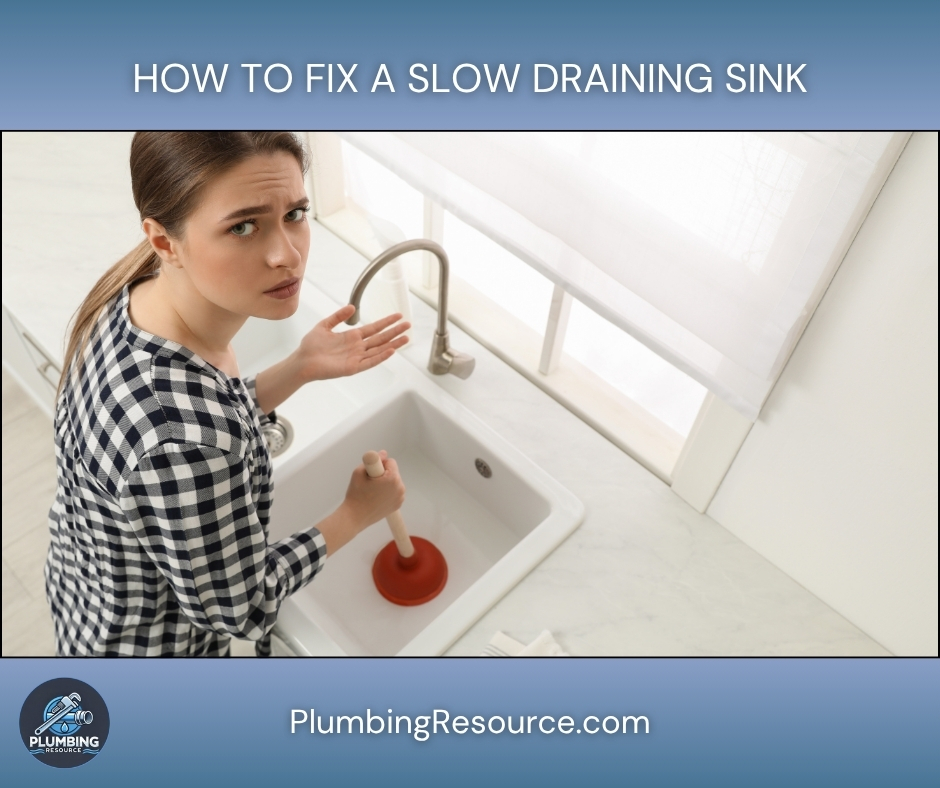
- Plunge (if no disposal):
- Block the overflow (bathroom) with a wet rag for a pressure seal.
- Fill the bowl with 2–3″ of warm water.
- Place a cup plunger over the drain opening; plunge in short, firm strokes (10–15 pumps).
- Flush again with hot water for 60–90 seconds; retest.
Kitchen with disposal: Don’t plunge the disposal side. If you must plunge, use the non-disposal basin and seal the disposal opening with a tight drain plug or a rubber test cap.
Step 3 — Wet/dry vacuum extraction (optional but powerful; 5–10 minutes)
Why: Suction can remove a stubborn wad without opening pipes.
- Seal the vacuum hose to the drain with a damp rag and tape. Block overflow holes.
- Switch to wet mode, turn on briefly (3–5 seconds), check for debris in the tank.
- Repeat from both above the drain and (in Step 5) below at the trap if needed.
Step 4 — Maintenance dosing (when flow improves but is not perfect)
Why: Enzyme products digest biofilm over hours/days for a slow-draining sink that’s mostly scum-based.
- At night, dose per label with a biodegradable enzyme cleaner; avoid running hot water for 6–8 hours.
- Resume normal use; repeat weekly for prevention.
Reality check: Baking soda + vinegar can help with odors and light film but rarely clears a real restriction. Enzymes are better for biofilm; mechanical removal is best for hair or solid grease.
Step 5 — Open and clean the P-trap (20–30 minutes; Moderate)
Why: If the slow-draining sink persists, the clog is often in the trap or trap arm.
- Prepare: Place a bucket under the trap; lay a towel.
- Loosen slip nuts on both sides of the P-trap using hands or pliers (protect chrome with a cloth).
- Remove the trap carefully—expect water. Inspect for sludge, hair, jewelry (!).
- Clean: Use a bottle brush and rag; rinse the trap with warm water.
- Inspect washers: Replace any cracked or flattened slip-joint washers.
- Check the trap arm (wall side):
- Shine a flashlight inside.
- If gunk is visible within a few inches, proceed to Step 6 to snake.
- Reassemble: Ensure the trap is oriented correctly (water seal toward the fixture). Hand-tighten, then snug 1/8–1/4 turn with pliers—don’t overtighten.
- Leak & flow test: Run warm water 2–3 minutes while checking every joint. Wipe dry and re-check after 5 minutes for seeping.
Step 6 — Snaking the trap arm/branch line (15–25 minutes; Moderate)
Why: When the trap is clean but the slow-draining sink remains, the restriction is farther downstream.
- Remove the trap again (if reinstalled).
- Feed a 1/4″ or 5/16″ hand auger into the trap arm toward the wall. Turn clockwise while advancing; don’t force.
- Feel resistance? Keep steady rotation to bite, then advance/withdraw to break up and pull debris.
- Retrieve and clean the cable as you reverse feed.
- Flush: Reassemble the trap; run hot water for 3–5 minutes.
- Still slow? Repeat, or consider a longer reach (up to 10–15 ft) if your branch is longer.
Double-bowl kitchens: If both bowls are slow, snake the common tailpiece or the branch after the tee. If only the disposal side is slow, see Step 7.
Step 7 — Special kitchen cases (disposal & dishwasher)
Garbage disposal present:
- Reset basics: Run cold water, turn on the disposal 30–45 seconds.
- Clear the baffle: Food pulp collects at the rubber splash guard; remove and scrub.
- Check the dishwasher knockout: If your dishwasher was recently installed and water backs up, the knockout plug on the disposal’s side inlet may not have been removed—disconnect the hose and verify.
- Snake order: If slow persists, snake from the non-disposal bowl or from the trap arm with the trap removed (preferred).
Grease-heavy drains:
- Grease solidifies in the trap arm/branch. After snaking, run a long hot-water flush with a few drops of dish soap to emulsify residual film. Follow up with enzyme maintenance for two weeks.
Step 8 — Bathroom pop-up linkage fix (if stopper action is weird)
- With the stopper removed, disassemble the pivot rod and clevis strap.
- Clean and re-grease the pivot ball with a tiny dab of silicone grease.
- Reassemble so the stopper seats/retracts fully; adjust the clip along the clevis for proper height.
- Test for both seal (holds water) and drain speed (retracts fully).
Step 9 — When the slow-draining sink isn’t the sink (venting & deeper blockages)
If you notice any of the following, the problem is likely beyond the fixture and not DIY-friendly:
- Multiple fixtures draining slowly or gurgling (e.g., sink and tub).
- Gurgling from the sink when another fixture drains (vent issue).
- Sewage odors, standing water in other drains, or backups at floor drains.
- Very old galvanized or cast-iron branch lines that repeatedly re-clog.
Action: Stop and consult a licensed plumber for a longer cable, camera inspection, or vent evaluation.
Leak-proof reassembly checklist
- Slip-joint cone washer orientation correct (taper faces the joint).
- Nuts threaded by hand first to avoid cross-threading.
- Final snug only 1/8–1/4 turn with pliers.
- Wipe joints dry and re-check in 5–10 minutes.
- Keep a few spare washers in a labeled zip bag in the vanity.
Prevention plan (keep that slow-draining sink gone)
- Weekly: Hot water flush for 60–90 seconds.
- Monthly: Enzyme cleaner overnight per label.
- Quarterly: Remove and clean pop-up or grid top; scrub tailpiece entrance.
- Kitchen rules: Wipe greasy pans with a paper towel before washing; use the trash for coffee grounds, fibrous peels, and eggshells.
- Hair control: Install a hair-catching screen in bathroom sinks with long-hair users.
Quick troubleshooting matrix
| Symptom | Likely Cause | First Fix | Next Fix |
|---|---|---|---|
| Slow only at one sink | Stopper biofilm/hair | Step 1–2 cleanup | Step 5–6 |
| Slow on both kitchen bowls | Common branch restriction | Step 5–6 | Pro service if repeat |
| Disposal side backs up into other bowl | Partial clog after tee | Step 7 + Step 6 | Pro service |
| Gurgling sounds | Vent restriction/air lock | Step 6 try; if persists | Pro service |
| Returns days after cleaning | Deeper build-up/old pipe | Step 6 + enzyme program | Camera/jetting |
Final word
Most slow-draining sink issues are shallow and respond to stopper cleaning, zip-striping, a good plunge, or a trap clean-out. Move through the ladder, escalate only as needed, and you’ll restore smooth, swirl-free drainage—without mess or guesswork.